
SHOTENKENCHIKU /December
2025/11/28 2025
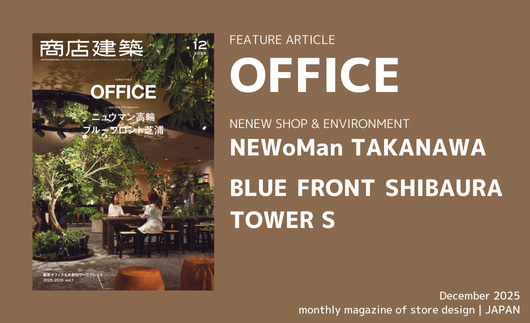
SHOTENKENCHIKU is monthly magazine of Japanese interior design / store design / commercial architecture
December 2025, SUMMARY
NEW SHOP & ENVIRONMEN
NEWoMan TAKANAWA
BLUE FRONT SHIBAURA TOWER S
FEATURE ARTICLE
OFFICE
------------------------------------------------------------------------------------------------------------
NEW SHOP & ENVIRONMENT
NEWoMan TAKANAW
(Page 42)
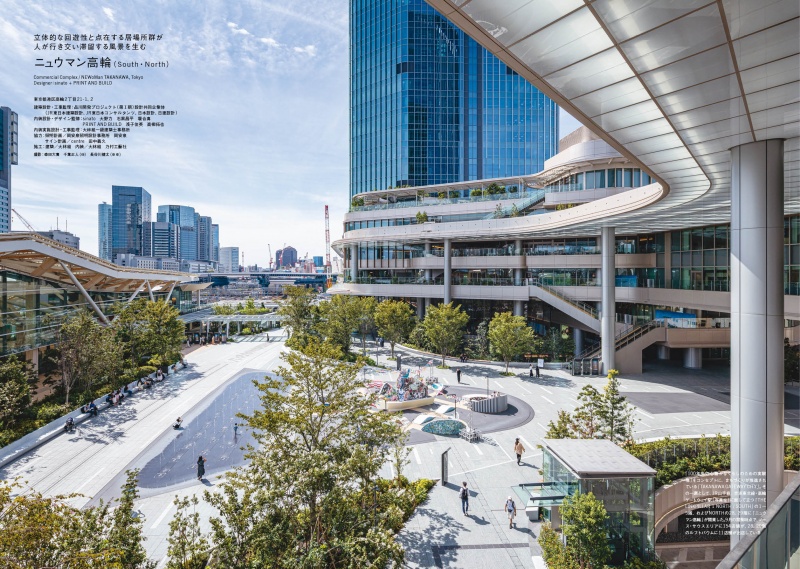
A massive commercial facility spanning a total floor area of
50,000 square meters. The building footprint measures 360m by
70m, with the commercial zone positioned to span the twin towers
extending north and south. The site is a former vehicle depot, a
location lacking strong urban context. Consequently, the
environmental design for the commercial facility was planned as if
creating a new town. Adopting a central core configuration, the
high-rise core occupies most of the space. To avoid this, eight
small to medium-sized vertical voids were strategically placed.
Small plazas and roundabouts were also incorporated between
these voids, with scattered three-way intersections creating
pathways that encourage exploration deeper into the complex.
This plan envisions a commercial space with a strong public
character, designed for diverse people to pass through and linger.
Designer : sinato + PRINT AND BUILD
NEW SHOP & ENVIRONMENT
BLUE FRONT SHIBAURA TOWER S
(Page 106)
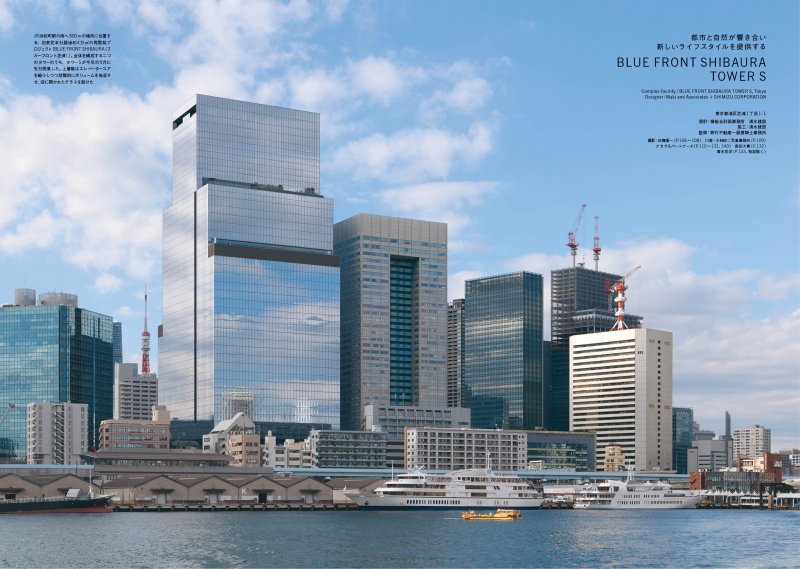
BLUE FRONT SHIBAURA, a redevelopment project spanning
approximately 40,000 square meters on the former Toshiba
headquarters site, is located 300 meters south of Hamamatsucho
Station. Positioned as a key junction connecting Tokyo’s bay area
and the city center, it consists of two towers. The Tower S opened
first in this September. Its lower floors feature dining space open
to the city, mid-levels house office space, and upper floors
accommodate hotels and residences. Conceptualized as a “Tokyo
& Nature Experience,” this mixed-use complex leverages its
location as the closest site to the sea within the Yamanote Line
loop, to propose a new lifestyle that harmonizes nature and the city.
Designer : Maki and Associates + SHIMIZU CORPORATION
FEATURE ARTICLE
OFFICE
TENJIN SUMITOMO LIFE FJ BUSINESS CENTER Reboot!
(Page 144)
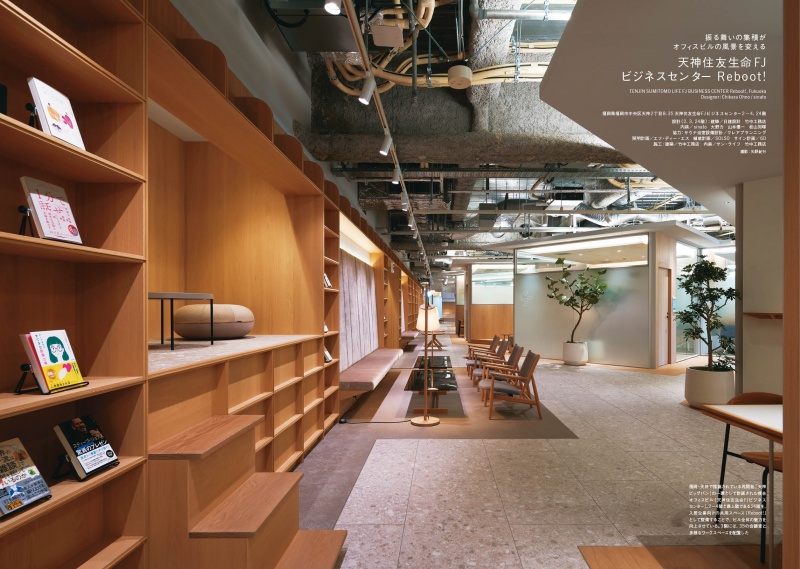
This office building was planned as part of the “Tenjin Big Bang”
redevelopment project in central Fukuoka. Its goal is to update the
conventional office building type by allocating large shared spaces
for tenant companies on the 2nd to 4th floors and the top floor.
On the third floor, private rooms like meeting rooms are arranged
in clusters at an angle to the structural grid. The spaces between
these clusters provide areas suitable for solo work or open
meetings, creating an environment that balances unobstructed
sightlines with a sense of enclosed tranquility. Additionally, a
tenant café on the second floor seamlessly connects to the
outdoors, while the top floor features a sauna. The goal was to
enhance the value of working together by forming commons
where the activities of different companies overlap.
Designer : sinato
FEATURE ARTICLE
OFFICE
TAKANAWA GATEWAY Link Scholars' Hub(LiSH) Studio1
(Page 160)
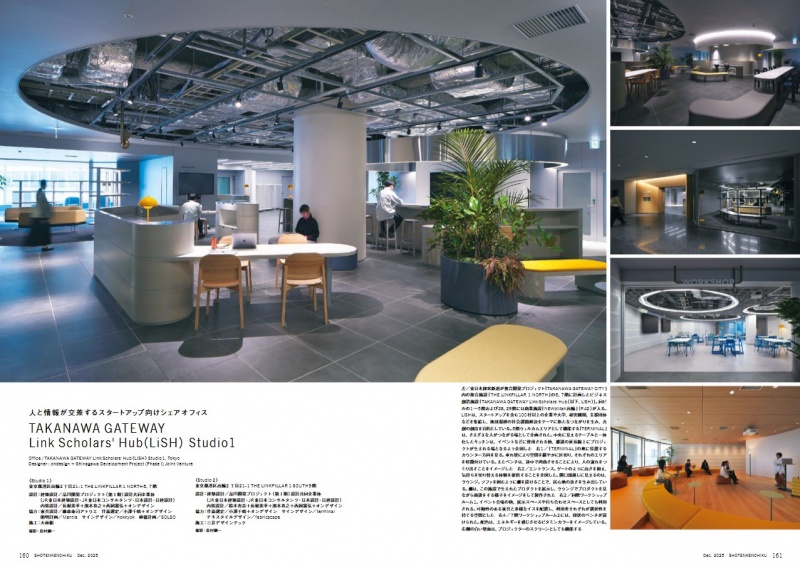
LiSH is a two-story incubation facility. The sixth floor is designated
as “TERMINAL,” where people and information flow, while the
seventh floor is divided into “SQUARE,” where they gather, and
“TOWN,” which fosters a sense of belonging. The “TERMINAL”
connects spaces using wainscoting and suspended walls, while
directionless furniture allows sightlines and pedestrian flow to
change dynamically. The ‘SQUARE’ features gently curved
furniture, suspended walls, and wainscoting to create highly
enclosed zones. The “TOWN” arranges various home offices at
different angles, forming a space with no dead ends.
Designer : ondesign + Shinagawa Development Project (Phase I)
Joint Venture
FEATURE ARTICLE
OFFICE
SYMBOLPLUS OFFICE
(Page 167)
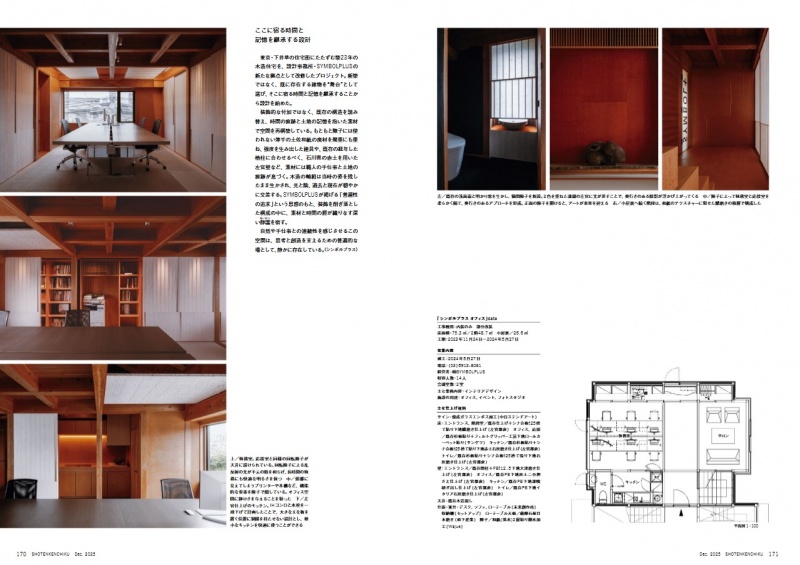
SYMBOLPLUS rebuilt its office space as a foundation for thought
and creation during its renovation. Utilizing the soft wooden
framework, chemical materials were eliminated, and natural
materials like plaster and washi paper were primarily employed.
Plastering using red clay from Ishikawa Prefecture was applied in
three distinct layers to adjust texture, achieving both practicality
and beauty. Tosa washi paper shoji screens bring warmth and
flexibility, while the reception room allows for variable partitioning
into private spaces and concealing storage. This space embodies
the company’s philosophy: rooted in the memory of the land and
the background of materials, pursuing universal value.
Designer : SYMBOLPLUS
FEATURE ARTICLE
OFFICE
NOT A HOTEL OFFICE
(Page 172)
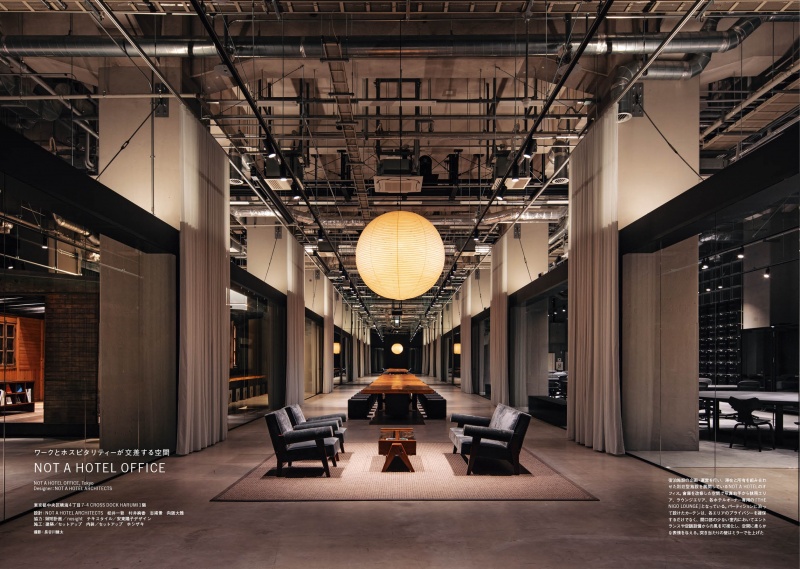
This project converted a building previously used as a warehouse
and exhibition space into an office and a place where hotel owners
can experience the NOT A HOTEL world. To utilize the existing
columned space with its approximately 7-meter ceiling height,
each area is partitioned with 3-meter-high walls. This creates
distinct zones while maintaining a sense of unity throughout the
building. In the owner-exclusive “NIGO’S Lounge,” the walls are
adorned with a collection gathered over 30 years by fashion
designer NIGO®, who oversees the direction, allowing guests to
experience the NOT A HOTEL world.
Designer : NOT A HOTEL ARCHITECTS
FEATURE ARTICLE
OFFICE
Spotify Japan
(Page 179)
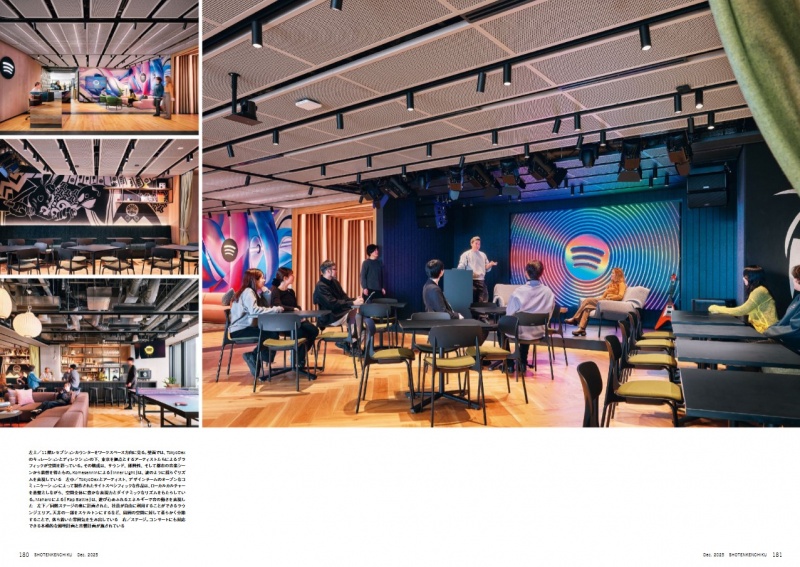
Spotify Japan’s office, opened in the heart of Tokyo’s Shibuya,
was conceived as a crossroads of creativity and culture. Through
collaboration between Spotify's internal team and a design studio,
it transcends the boundaries of a typical office, presenting a new
space that functions as an event venue, gallery, and community
hub. The design concept is “Disrupting the Beat.” Instead of a
linear office layout, the composition, like music, features variations
in pace. This creates a rhythmic space where “concentration and
openness,” “stillness and movement,” alternate.
Designer : Espo Atelier + DE-SIGN
FEATURE ARTICLE
OFFICE
FRONTIER CONSULTING Nagoya Branch
(Page 195)
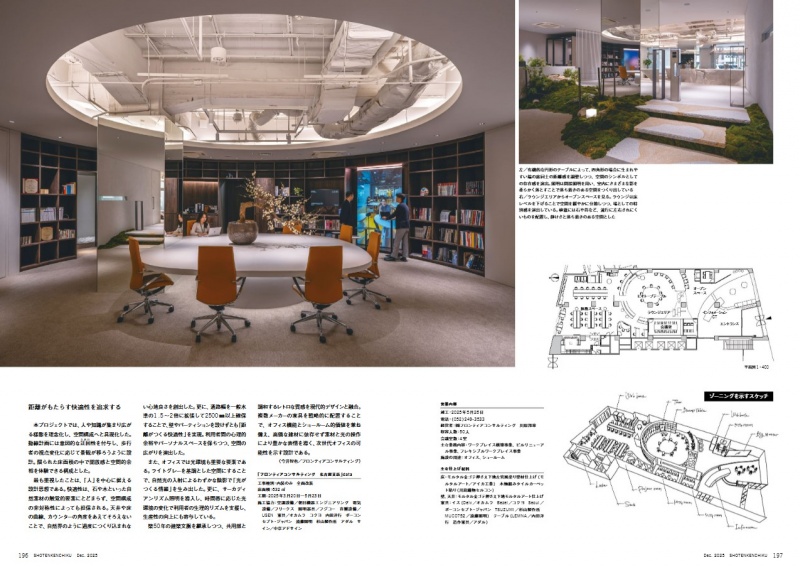
Frontier Consulting Nagoya Branch has relocated to a location
about a 4-minute walk from Nagoya Station in Aichi Prefecture.
Facing a major thoroughfare, the space reflects the “pulse of the
city” indoors, creating an environment that responds to the street.
The design philosophy centers on placing people at the core.
While incorporating natural materials like stone and wood, the
asymmetrical spatial composition creates an unforced,
comfortable atmosphere reminiscent of nature. Furthermore, by
using only indirect lighting in the predominantly gray space, the
subtle shadows created by natural light express the “mood
created by light.”
Designer : FRONTIER CONSULTING
SUBSCRIBE
Print Issue : For overseas subscription and order, please contact to the following
Digital Issue : zinio.com
BACK NUMBER
このエントリーのURL
URL